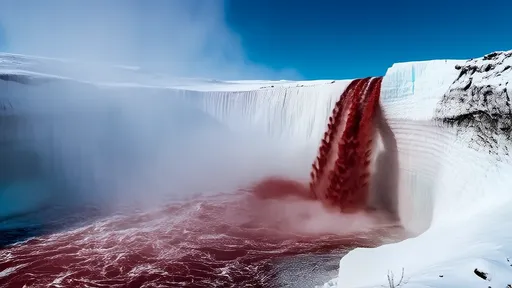
In the remote reaches of Antarctica, a bizarre and haunting phenomenon known as Blood Falls has captivated scientists and adventurers alike. This crimson waterfall, staining the white expanse of Taylor Glacier, is not the result of some macabre event but rather a window into an ancient, subterranean world. Recent research reveals that beneath the glacier lies a trapped body of seawater dating back an astonishing two million years, offering unprecedented insights into Earth’s climatic past and the resilience of life in extreme environments.
The discovery of Blood Falls dates back to 1911, when Australian geologist Griffith Taylor first encountered the striking red stain on the glacier now named after him. Initially, the color was attributed to red algae, but later studies uncovered a far more fascinating explanation. The water, rich in iron, oxidizes upon contact with air, turning a vivid shade of rust—a process akin to how iron nails corrode over time. Yet, the true marvel lies not in the waterfall’s appearance but in its origin: a hidden, hypersaline lake buried beneath 400 meters of ice.
What makes this subglacial reservoir extraordinary is its age. Isolated for millennia, the water is a relic of the ancient oceans that once covered Antarctica before it froze over. Analysis of the water’s chemistry and isotopic composition confirms its marine origin, with salt concentrations nearly three times that of modern seawater. This briny liquid remains liquid despite the freezing temperatures, a testament to the unique properties of saline water under pressure.
The implications of this discovery are profound. For decades, scientists have speculated about the existence of isolated ecosystems beneath Antarctica’s ice sheets, and Blood Falls provides concrete evidence. Microorganisms thriving in this dark, oxygen-deprived, and iron-rich environment challenge our understanding of life’s limits. These microbes, cut off from sunlight and organic nutrients, survive by metabolizing sulfur and iron compounds—a process known as chemosynthesis. Their existence raises tantalizing questions about the potential for life on icy moons like Europa or Enceladus, where similar conditions may prevail.
Beyond astrobiology, the ancient seawater beneath Taylor Glacier serves as a time capsule of Earth’s climatic history. By studying its composition, researchers can reconstruct the atmospheric and oceanic conditions of a time when Antarctica was transitioning from a temperate continent to the frozen desert we know today. The water’s isotopic signatures hint at periods of warming and cooling, offering clues about how the planet’s climate systems respond to drastic changes—a pressing concern in the age of global warming.
Unlocking the secrets of Blood Falls has required ingenuity. Traditional drilling methods risk contaminating the pristine environment, so scientists have turned to non-invasive techniques like radar and seismic surveys to map the subglacial plumbing. In 2017, a team using ice-penetrating radar confirmed the presence of a network of brine channels feeding the falls, revealing how the water travels from the buried reservoir to the surface. These findings suggest that similar liquid pockets could exist elsewhere beneath Antarctica’s ice, potentially harboring other ancient ecosystems.
The study of Blood Falls also underscores the fragility of these hidden worlds. As climate change accelerates, the stability of Antarctica’s ice sheets becomes increasingly uncertain. Thawing ice could disrupt these sealed environments, releasing their contents into the modern ocean—a scenario with unpredictable consequences for marine chemistry and biology. Protecting these natural laboratories while studying them is a delicate balance, one that requires international cooperation and stringent environmental protocols.
For now, Blood Falls remains one of the planet’s most enigmatic landmarks, a stark reminder of how much we have yet to learn about Earth’s past and the extremes of life. Its existence blurs the line between geology and biology, between the ancient and the contemporary. As research continues, this crimson cascade may yet yield more secrets, deepening our understanding of the planet’s history and the tenacity of life in the most inhospitable corners of the world.

By /Jun 7, 2025

By /Jun 7, 2025

By /Jun 7, 2025

By /Jun 7, 2025

By /Jun 7, 2025

By /Jun 7, 2025
By /Jun 7, 2025

By /Jun 7, 2025

By /Jun 7, 2025

By /Jun 7, 2025
By /Jun 7, 2025
By /Jun 7, 2025
By /Jun 7, 2025
By /Jun 7, 2025
By /Jun 7, 2025
By /Jun 7, 2025
By /Jun 7, 2025
By /Jun 7, 2025
By /Jun 7, 2025
By /Jun 7, 2025